Where to Watch Spain vs France and England vs Argentina in Oslo During Your Stay

Norway is no longer part of the FIFA World Cup, but that does not mean football has disappeared from Oslo. If you are visiting the city, you will still find plenty of people gathering to watch the biggest matches together.

If you want to watch Spain vs France or England vs Argentina during your stay, these are three of the best places to consider. They offer different atmospheres, so it helps to know what to expect before you head out.

Where should you watch the matches?

Fotball i Sentrum (Spikersuppa) ⭐⭐⭐⭐⭐

For many visitors, this is the easiest and most enjoyable choice. Spikersuppa is right in the city centre, within walking distance of Oslo Central Station, Karl Johans gate and many hotels.

The atmosphere is usually lively, especially for major international matches. Expect large crowds if you arrive close to kick-off. If you want a good view of the screen, arrive early rather than just before the match starts.

There are plenty of restaurants, cafés and convenience stores nearby if you want food or drinks before or after the game. Public transport is excellent, with trams, buses, trains and the metro all stopping within a few minutes’ walk.

Fotball i parken (Lille Slottsparken) ⭐⭐⭐⭐☆

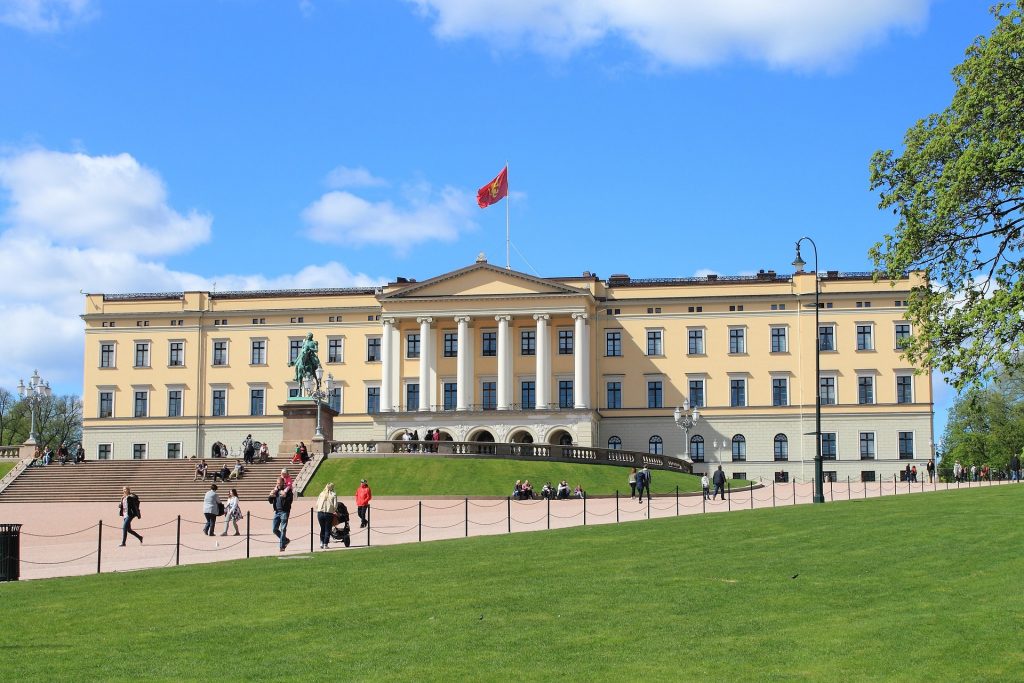
If you prefer watching football outdoors in a greener setting, Lille Slottsparken is another good option. It is close to the Royal Palace and easy to reach on foot from the city centre.

The atmosphere is often a little more relaxed than at Spikersuppa, although popular matches can still attract many spectators. Because you are outdoors, check the weather forecast before leaving your hotel. Even during summer, evenings in Oslo can feel cool, particularly if you are visiting from a much warmer climate. Bringing a light jacket is usually a good idea.

Carls (Carl Berners plass) ⭐⭐⭐⭐☆

Carls is a popular sports venue at Carl Berners plass, a few stops from the city centre by tram or bus. If you prefer watching indoors with food and drinks available throughout the match, this can be a comfortable alternative.

As with many popular sports bars, tables may fill up well before kick-off for high-profile matches. If you are travelling with a group, arriving early gives you a much better chance of sitting together.

How do you get there?

All three locations are easy to reach using Oslo’s public transport network.

  • Spikersuppa: a short walk from Oslo Central Station.
  • Lille Slottsparken: around 10 to 15 minutes on foot from the city centre.
  • Carls: accessible by tram and bus to Carl Berners plass.

If you are staying centrally, you may not need public transport at all for Spikersuppa or Lille Slottsparken.

What should you wear?

Weather is the biggest factor. Summer evenings in Oslo are often pleasant, but temperatures can drop noticeably after sunset. If you have been travelling in southern Europe or another hot destination, Oslo may feel much cooler than you expect.

For outdoor screenings, comfortable shoes and a light waterproof jacket are sensible choices. Rain showers are always possible, even on days that start with sunshine.

What about toilets, food and waiting times?

The city centre locations have cafés, restaurants and shops nearby, although queues become longer before the match starts and during half-time. Public toilets are generally easier to find around central Oslo than in smaller parks, but you may still have to wait if attendance is high.

If you want to avoid missing part of the match, consider buying food and drinks before kick-off instead of waiting until the interval.

Can you still follow the matches online?

If you cannot get a place at one of the public screenings or you prefer watching from your accommodation, you can also check this guide on how to watch Spain vs France online. It explains available viewing options and can help if you are travelling during match day.

Is it worth joining the crowds?

Even without Norway in the tournament, international football still brings together locals and visitors across Oslo. If you enjoy watching major matches with other fans, these venues provide a good atmosphere without requiring much planning. Just arrive early for the biggest games, dress for changing weather, and expect some queues around kick-off and half-time.
Where to Watch Norway vs England Live in Oslo: Giant Screens, Sports Bars, and Streaming Options

Norway takes on England in the FIFA World Cup quarter-finals on Saturday, July 11, with kick-off at 23:00 (CEST). For Norwegian football fans, this is one of the biggest matches in modern history. A victory would send Erling Haaland, Martin Ødegaard and the rest of the squad into the World Cup semi-finals, something that would rank alongside Norway’s legendary win over Brazil at the 1998 World Cup.

If you’re spending Saturday evening in Oslo, expect an unforgettable atmosphere. Tens of thousands of supporters are expected to fill the city centre, and the best places to watch the match will reach capacity well before kick-off.

1. Rådhusplassen – Oslo’s Biggest Football Party

The official place to watch the match is Rådhusplassen (City Hall Square), where the City of Oslo will once again show the match on four giant screens after the huge success of the Brazil game.

Around 50,000 supporters gathered here for the round-of-16 victory over Brazil, and at least as many are expected for the England match.

What to expect

  • Free admission
  • No tickets required
  • Four giant screens
  • Incredible atmosphere with thousands of Norwegian supporters
  • Family-friendly event
  • Live NRK studio before and after the match

Good to know

There are security checks at the entrances, so expect queues if you arrive late.

There are no seats, so most people will stand throughout the evening. You’re welcome to bring a sitting pad (sitteunderlag) if you want to sit before kick-off, but chairs are not permitted.

Alcohol is not allowed, and visitors may not bring alcoholic drinks or glass bottles into the event area.

Water stations and hundreds of portable toilets will be available, while food trucks will operate close to the square.

How to get there

The easiest way is to walk from Nationaltheatret or Stortinget stations.

Because of the huge crowds, expect temporary road closures and changes to tram and bus services around City Hall. Public transport operator Ruter is running additional late-night services after the match.


2. Sports Bars Around the City Centre

If you prefer a roof over your head and easier access to food and drinks, Oslo has plenty of excellent alternatives.

Popular venues include:

  • Carls – Norway’s largest football pub with multiple giant screens.
  • HOBO Bar – A relaxed city-centre venue showing selected World Cup matches.
  • Posthallen Drinkhub – One of Oslo’s most popular sports viewing venues.
  • Haandtryk – Indoor viewing plus a courtyard with outdoor screens.
  • Chicago Pizza & Brew – Sports bar inside the Radisson Blu Plaza Hotel.

For most sports bars, arriving early is highly recommended. Many will either accept reservations or fill up several hours before kick-off.


3. Outdoor Football Viewing

If you enjoy watching football outdoors but want alternatives to Rådhusplassen, Oslo offers several excellent options.

Fotball i Sentrum (Spikersuppa)

Located just off Karl Johans gate, this popular outdoor football area shows all World Cup matches on large screens.

  • Free entry
  • Age limit: 18+
  • Great city-centre atmosphere

Fotball i Parken (Lille Slottsparken)

A slightly more relaxed outdoor setting close to the Royal Palace.

  • Outdoor giant screen
  • Age limit: 20+
  • Food and drinks available
  • Booking options available

Prefer Watching From Home?

If you’d rather skip the crowds, the queues, and Oslo’s expensive beer prices, streaming the match from your hotel, apartment, or home is an excellent option.

The match is broadcast in Norway, and if you’re staying in the country with a Norwegian internet connection, watching online is straightforward.

If you’re visiting Norway but are still connected through a foreign mobile provider or another country’s internet service, you may encounter regional restrictions. In that case, using a Norwegian IP address can solve the problem.

You can find a complete streaming guide here:

The guide explains exactly how to watch the match from Norway or from abroad, including step-by-step instructions for viewers who need a Norwegian IP address.

Final Tips

  • Arrive at least 2–3 hours before kick-off if you’re heading to Rådhusplassen.
  • Use public transport instead of driving.
  • Bring an extra layer of clothing—Oslo evenings can become chilly, even in July.
  • Charge your phone before leaving, as mobile networks may become congested around the city centre.
  • Most importantly, enjoy what could become one of the greatest nights in Norwegian football history.

Whether you choose the electric atmosphere at Rådhusplassen, a lively sports bar, or the comfort of your own sofa, Norway vs England promises to be a World Cup quarter-final to remember.

7 Places to Put on Your Checklist for a First Trip to Oslo

If you are visiting Oslo for the first time, it can be difficult to know which places belong on your sightseeing checklist. Cities such as Paris, London, and Rome have landmarks that almost everyone recognizes immediately. If you need inspiration for those cities, you can see similar first-visit checklists from guidetoparis.net, guidetolondon.net, and rometourist.net.

Oslo is different. It is not a city filled with monumental architecture on every corner, and many of its best-known places are parks, waterfront areas, and viewpoints rather than famous buildings. Even so, there are a few locations that most first-time visitors should see before deciding what else to add to their itinerary.

The seven places below give you a good introduction to Oslo. They are easy to combine with other sightseeing, and together they show different sides of the city.

Which places should you prioritize?

1. Vigeland Sculpture Park

Vigeland Sculpture Park is probably Oslo’s most recognizable attraction. Hundreds of granite and bronze sculptures fill a large public park that you can visit free of charge, and you should expect to spend at least one to two hours walking around. Wear comfortable shoes, as the park is bigger than many first-time visitors expect, and remember that it is completely outdoors, so the weather matters.

2. Akershus Fortress

Akershus Fortress sits above the Oslo Fjord and offers a combination of old stone buildings, open grounds, and good views of the harbor. It is an easy walk from the city center, but some paths are uphill and paved with uneven stones, so comfortable footwear is helpful. Even if you do not enter the museums, the fortress grounds are worth visiting.

3. Aker Brygge

Aker Brygge is Oslo’s modern waterfront promenade, lined with restaurants, cafés, and places to sit by the water. It is especially busy on warm days and summer evenings, while winter visits are much quieter. Food and drinks here are generally more expensive than in many other parts of the city, but walking along the waterfront costs nothing.

4. City Hall

Oslo City Hall is one of the city’s most important public buildings and is known internationally as the place where the Nobel Peace Prize ceremony is held. The building is within walking distance of both Aker Brygge and the National Theatre area, making it easy to include in the same day. The exterior is simple, but many visitors find the decorated interior more interesting than they expected.

5. Parliament

The Norwegian Parliament stands along Karl Johans gate, the main street connecting the Central Station with the Royal Palace. Most visitors stop here while walking through the city center, making it one of the easiest landmarks to see without any extra travel. It is a good reference point as you move between several of Oslo’s central attractions.

6. The Oslo Opera House

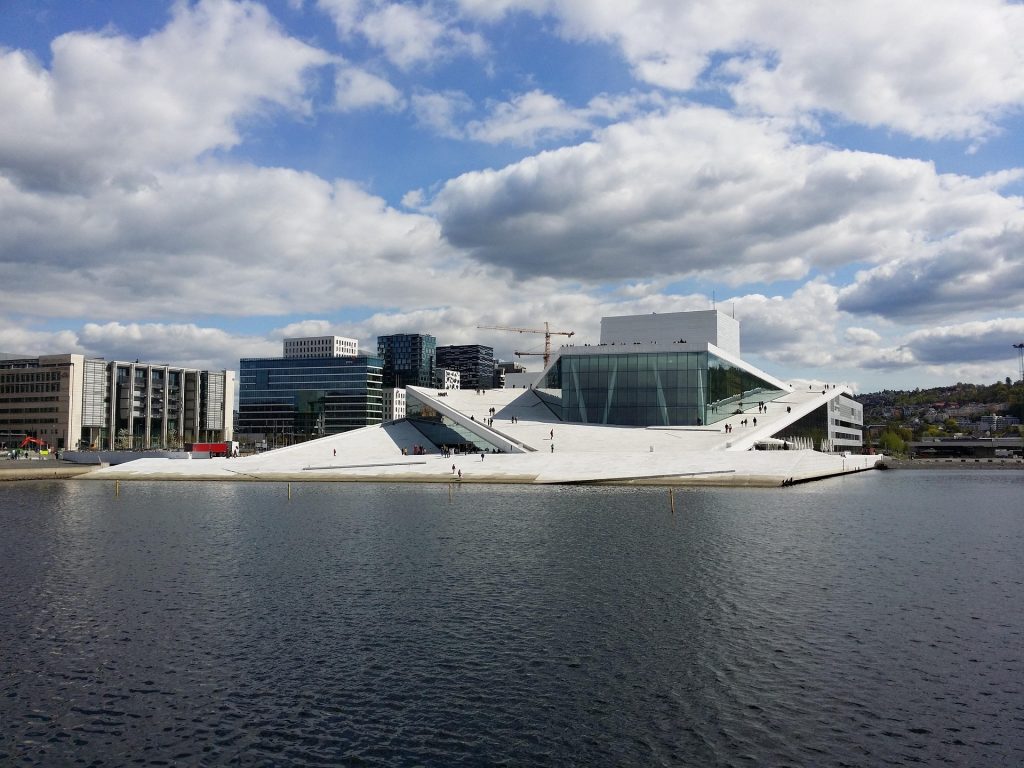
The Oslo Opera House is the city’s most striking modern building and is one of the few landmarks that immediately stands out in photographs. You can walk onto the sloping white roof for views across the fjord and the surrounding neighborhoods, but the surface can become slippery in rain, snow, or ice. It is only a short walk from Oslo Central Station, making it an easy first stop after arriving by train.

7. Holmenkollen

Holmenkollen is best known for its famous ski jump and for offering one of the best panoramic views over Oslo and the fjord. Reaching it takes longer than the central attractions because you need to travel into the hills by public transport, but the journey is straightforward and worth planning into your schedule. The temperature is often lower here than in the city center, so bring an extra layer if you visit on a cool day.

What about the museums?

Many visitors also plan time for the Munch Museum, the National Museum, and other museums around Oslo. They are excellent choices if you have extra time or particular interests, but if your goal is to see the places most closely associated with the city on a first visit, the seven locations above are a practical starting point.

Most of these attractions can be combined over one or two days using public transport and walking. Oslo’s city center is relatively compact, although Holmenkollen requires additional travel. If you leave with memories of Vigeland Sculpture Park, Akershus Fortress, Aker Brygge, City Hall, Parliament, the Opera House, and the view from Holmenkollen, you will have seen the places that many visitors associate with their first trip to Oslo.

Where to Cool Down in Oslo on a Hot Summer Day

Most summer days in Oslo are comfortable rather than hot. But every now and then, the temperature climbs above 30°C. If you have arrived from another warm country, you might think the water will also be warm. It usually is not.

Whether you choose the Oslofjord or a forest lake, the water is often much colder than beaches around the Mediterranean. That can be a welcome relief after walking around the city in the sun. If you are unsure what weather to expect during your visit, have a look at our guide to Oslo’s weather.

The places below are all easy to reach without a car. If you are unfamiliar with the local transport system, our guide to public transportation in Oslo explains how to use the metro, trams, buses and ferries.

Should you choose the sea or a lake?

The Oslofjord offers salt water, small beaches, rocks for sunbathing and plenty of space along the shoreline. Forest lakes are surrounded by trees, often feel quieter, and the fresh water is popular with families. Neither the sea nor the lakes become very warm, even after several hot days. If you jump straight in, expect the first few seconds to feel surprisingly cold.

Huk Beach on Bygdøy

Huk is one of Oslo’s best-known places for swimming in the fjord. You will find both sandy areas and smooth rocks where people spread out towels. On very hot weekends it gets busy, so arriving before midday gives you a better chance of finding a comfortable spot.

How do I get there?

Take bus 30 towards Bygdøy and get off at Huk. The journey from the city centre takes around 20–30 minutes, depending on traffic. During the summer season you can also use the passenger ferry to Bygdøy and walk from the pier, although the walk takes around 20 minutes.

There are toilets, seasonal kiosks selling ice cream and drinks, and mobile phone coverage is good. Bring water, as queues at the kiosk can become long on the hottest days.

Sørenga Seawater Pool

If you are already in the city centre, Sørenga is the easiest place to cool down. It is a modern waterfront area with swimming ladders, floating platforms and a protected seawater pool. There is very little natural shade, so sunscreen and a hat are useful if you plan to stay for several hours.

How do I get there?

Walk about 15 minutes from Oslo Central Station, or take a bus to the Bjørvika area. The water is clean, but the area can become extremely crowded on hot afternoons. If you prefer a quieter place, choose one of the forest lakes instead.

There are public toilets nearby, several cafés and grocery shops within walking distance, and drinking water is available.

Sognsvann

Sognsvann is a large freshwater lake surrounded by forest, making it a popular escape when the city feels too hot. The atmosphere is relaxed, and there is plenty of space even when many people visit.

How do I get there?

Take Metro line 5 to Sognsvann. The lake is only a couple of minutes’ walk from the station, making it one of the easiest natural swimming areas to reach by public transport.

There are toilets near the entrance to the recreation area. You can walk all the way around the lake on a wide gravel path of about 3 kilometres if you feel like stretching your legs after your swim. Bring your own food if you plan to stay, as there are limited places to buy refreshments.

Nøklevann

If you would rather avoid the biggest crowds, Nøklevann in eastern Oslo is a good alternative. The lake has several swimming spots, including small beaches and rocky areas. The surrounding forest makes it feel much further from the city than it really is.

How do I get there?

Take Metro line 3 to Bogerud or Metro line 1 to Ulsrud. From either station, expect a walk of around 15–20 minutes through residential streets and forest paths before reaching the water. Wear comfortable shoes rather than flip-flops for the walk.

Facilities are more limited than at central beaches, so bring water, snacks and anything else you need for the afternoon. Mobile coverage is generally good.

What should you bring?

Even on Oslo’s hottest days, it is worth packing a light towel, swimwear, sunscreen, drinking water and something warm to put on afterwards. After swimming in cold water, especially if there is a breeze, you may cool down faster than expected.

If you are only visiting Oslo for a few days and happen to experience one of those rare 30°C afternoons, joining the locals at the beach or a forest lake is one of the simplest ways to stay comfortable. Just don’t expect tropical water temperatures. The cool water is exactly why these places are so popular when the city heats up.

Where to Watch Norway vs Brazil in Oslo on July 5

If you are in Oslo on July 5 and want to watch Norway play Brazil together with thousands of local fans, you have a couple of very good options. Whether you prefer a ticketed event with other supporters or a free public screening in the city center, you can be part of the atmosphere.

If Norway wins, you can also expect celebrations around the city afterward. Large crowds often gather in central Oslo after major sporting victories, so be prepared for busy streets and public transport later in the evening.

Where can you watch the match?

There are two main places to watch the game with other supporters in Oslo.

Ullevaal Stadium

If you want a more organized event, you can watch the match at Ullevaal Stadium.
Update: Those tickets were quickly sold out (Ullevaal Stadium tickets), so no more tickets left for that event. But there is a similar event at Rockerfeller/Sentrum Scene (concert venues in the center of Oslo. Tickets are available through Ticketmaster, with prices starting at around 150 NOK.

Since this is a ticketed event, it is a good idea to buy your ticket in advance rather than expecting availability on the day. Arriving early also gives you more time to get inside before the crowds build up.

Free screening at Oslo City Hall

If you would rather watch the match outdoors without buying a ticket, head to the large screens outside Oslo City Hall (Rådhuset). This is one of the biggest public viewing areas in the city and is expected to attract a large number of supporters.

The atmosphere here can become very lively before kick-off and especially if Norway scores. If you want a good view of the screen, arrive well before the match starts. Standing for the entire game is likely, so wear comfortable shoes.

What should you expect?

Both locations are likely to be busy. Public transport around central Oslo and Ullevaal Stadium may also be more crowded than usual before and after the match.

Weather in Oslo can change quickly, even during summer. If you choose the outdoor screening at City Hall, check the forecast before leaving. Bringing a light waterproof jacket is often a good idea if rain is possible.

If you are watching outdoors, remember that you will be standing outside for the duration of the match. Bring water if it is a warm day, and dress according to the weather rather than the calendar.

What happens if Norway wins?

No one can predict exactly where supporters will celebrate, but if Norway wins you should expect spontaneous gatherings in central Oslo.

After previous victories, fans gathered near the Royal Palace to celebrate together. Similar celebrations could happen again, although the exact locations will depend on how the evening develops.

If you plan to stay out after the match, be prepared for crowded streets and possible delays on buses, trams, and the metro as many people leave at the same time.

Can you watch the match online?

Yes. The match will also be available through the Norwegian broadcaster NRK.

If you are visiting Norway or are trying to watch from another country, you can read Oslo Guide’s instructions on how to watch NRK live from abroad.

If you would like additional streaming alternatives, you can also read this guide explaining how to watch Brazil vs Norway online.

Which option is best?

If you want the biggest public celebration without spending money, the free screening at Oslo City Hall is the obvious choice. Expect large crowds, plenty of noise, and a festive atmosphere throughout the match.

If you prefer a more structured event and do not mind paying for admission, Ullevaal Stadium is another excellent option with tickets starting at around 150 NOK.

Whichever option you choose, arrive early, expect plenty of fellow supporters, and be ready for a memorable evening if Norway delivers a strong performance against Brazil.

The Tram Lines in Oslo: Organized Chaos or Just Norwegian Logic?

You arrive in Oslo. The air is fresh, the fjord sparkles, and everything feels calm, clean, and… slightly confusing. Then you notice the tram tracks.

They are everywhere.

Crossing streets, splitting roads, sneaking between lanes, and occasionally appearing where you least expect them — like a polite but slightly unpredictable Norwegian guest.

Welcome to the tram system of Oslo.


So… How Many Tram Lines Are There?

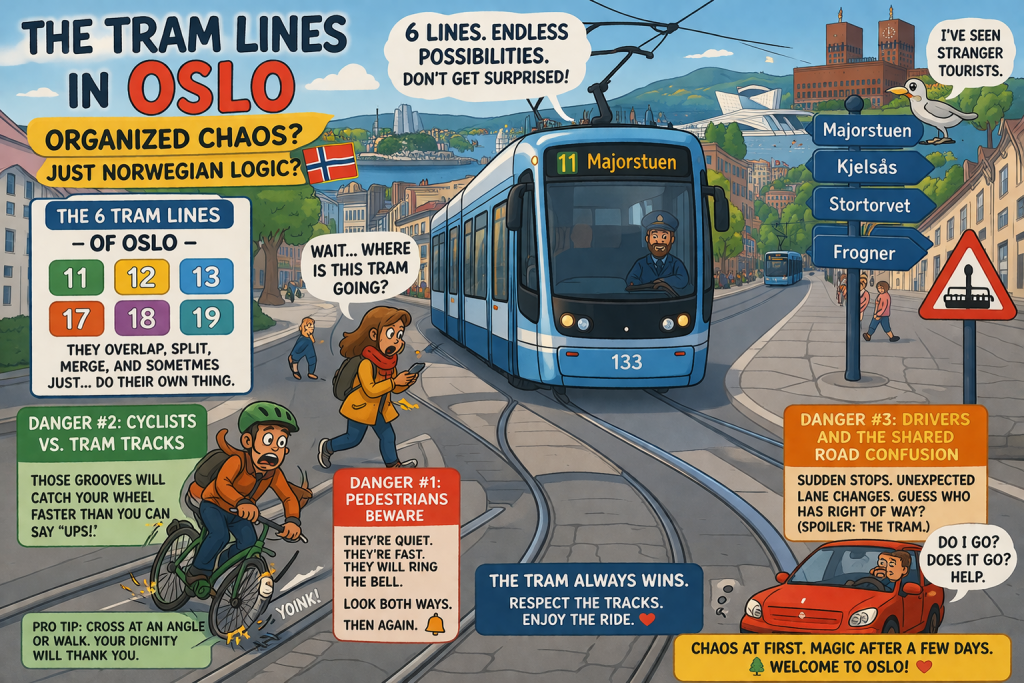
Let’s start simple. Oslo currently has 6 main tram lines:

  • Line 11
  • Line 12
  • Line 13
  • Line 17
  • Line 18
  • Line 19

Seems manageable, right?

Well… yes and no.

Because these lines don’t just run neatly side by side. Oh no. They overlap, split, merge, and occasionally take turns that make you question whether the tram driver is improvising.

If you want to explore the city and its attractions, the tram is actually a fantastic way to get around. You can hop on and off while discovering the best of the city through this handy guide to Oslo attractions.

But first… survival.


The “Wait, Where Is This Tram Going?” Experience

Unlike in some cities where each line has a very clear, straight route, Oslo trams love variety.

A single stop might serve:

  • 3 different lines
  • Going in 2 different directions
  • With destinations that sound vaguely familiar but not quite

So you stand there, staring at the sign like:

“Is this going where I think it is… or am I about to end up in the Norwegian wilderness?”

(Spoiler: You won’t. But it feels like it.)


Oslo vs Amsterdam: Tram Cousins with Attitude

If you’ve ever been to Amsterdam, this might all feel oddly familiar.

In fact, there’s a great comparison in this article about how the two cities share some surprisingly similar traits when it comes to trams:
Tre ting Amsterdam og Oslo har til felles

Both cities have tram systems that:

  • Look calm on the surface
  • Function efficiently
  • But can absolutely surprise you when you least expect it

The key takeaway?
Respect the tram. Always.


Danger #1: The Silent Approach (Pedestrians Beware)

Here’s the thing about Oslo trams…

They are quiet.

Not “gentle whisper” quiet, but quiet enough that:

  • You’re checking your phone
  • You step onto the tracks
  • And suddenly there’s a tram right behind you

They do have bells. And they will use them.

But relying on that is like relying on a polite warning before chaos.

👉 Rule number one:
Look both ways. Then look again. Then maybe one more time.


Danger #2: Cyclists vs Tram Tracks (A Classic Battle)

If you’re biking in Oslo, you’re going to meet the tram tracks.

And let’s just say… they are not your friend.

The grooves in the tracks are perfectly designed to:

  • Catch your wheel
  • Twist your bike
  • And send you into a slow-motion “why is this happening to me” moment

This is not theoretical. This is daily life.

👉 Pro tip:

  • Always cross tram tracks at an angle
  • Never ride parallel to them for long
  • And if in doubt… dismount and walk

Your dignity will thank you.


Danger #3: Cars and the “Shared Road Confusion”

Driving in Oslo?

Congratulations. You’ve unlocked expert mode.

Trams share the road with cars in many places, and that leads to:

  • Sudden stops
  • Unexpected lane changes
  • And moments where you’re unsure who actually has the right of way

(Spoiler: It’s usually the tram. It’s always the tram.)

👉 Golden rule:
If you and a tram disagree — you are wrong.


But Honestly… It Works

Here’s the funny part.

Despite all this:

  • The system is efficient
  • The trams are punctual
  • And locals navigate it like it’s the easiest thing in the world

After a day or two, you’ll start to get it.

After three days, you’ll feel confident.

After five days, you’ll be giving directions to confused tourists.


Should You Use the Tram as a Tourist?

Absolutely.

In fact, it’s one of the best ways to experience the city. You’ll glide through neighborhoods, pass parks, and get a real feel for Oslo beyond the main streets.

And if you want to find out what’s happening while you’re in town — festivals, events, or just something fun to do after your tram adventure — check out what’s happening in Oslo.


Final Thoughts: Chaos with Scandinavian Calm

Oslo’s tram system might feel like a puzzle at first:

  • Lines that overlap
  • Tracks that appear out of nowhere
  • And vehicles that move with quiet determination

But once you understand the rhythm, it all makes sense.

Kind of.

Just remember:

  • Look both ways
  • Respect the tracks
  • And never underestimate a tram

Because in Oslo…

The tram always wins.

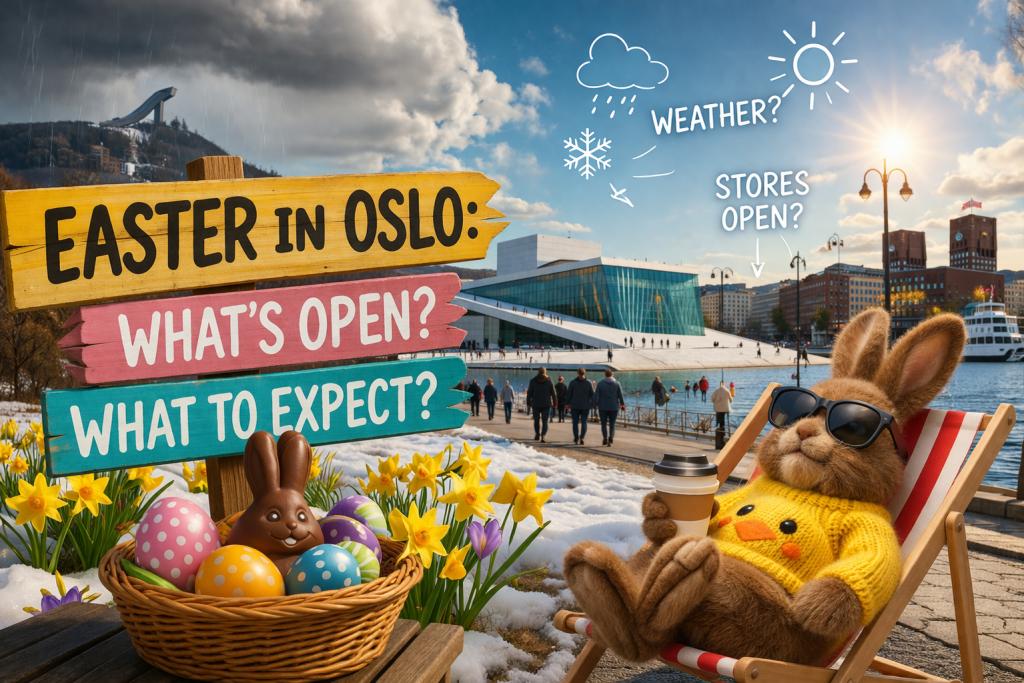
Opening Times in Oslo During Easter – What Should I Expect?

🐣 Will Oslo Shut Down… or Surprise You?

You’ve booked your trip, packed your bags, and suddenly it hits you:
“Wait… it’s Easter. Will everything be closed? Will I survive on chocolate eggs and gas station hot dogs?”

Fair questions.

Oslo during Easter can feel a bit like a Netflix series—sometimes calm and slow, sometimes unexpectedly lively, and occasionally… a little confusing if you don’t know what’s going on.

The good news? You won’t starve. The bad news? You might have to plan just a tiny bit.

Let’s break it all down.


🗓️ Easter in Norway – The Important Days

In Norway, Easter (Påske) is a big deal. Think cozy cabins, skiing, crime novels, and way too many oranges.

Here are the key public holidays:

  • Maundy Thursday (Skjærtorsdag) – Public holiday
  • Good Friday (Langfredag) – Public holiday
  • Easter Sunday (1. påskedag) – Public holiday
  • Easter Monday (2. påskedag) – Public holiday

And yes… schools are closed for most (or all) of the week leading up to Easter.

Translation: Norwegians disappear into the mountains like seasonal creatures 🏔️🐰


🛒 Grocery Stores – Your Lifeline

Here’s the reality:

  • Normal weekdays before Easter: Open as usual (sometimes extended hours)
  • Maundy Thursday + Good Friday + Easter Sunday + Monday:
    👉 Most stores are closed
  • BUT… small convenience stores (søndagsåpne butikker) stay open!

These are your heroes:

  • Small Joker, Bunnpris, or Kiwi stores
  • Gas stations
  • 7-Eleven / Narvesen

They’re smaller and a bit pricier—but hey, survival mode activated.

👉 Pro tip: Buy snacks in advance unless you enjoy panic-buying chocolate eggs at double price.


🛍️ Fashion & Shopping Streets – Window Shopping Season?

  • Karl Johans gate & shopping centers:
  • Open on regular weekdays
  • Closed on public holidays

So yes… Easter can turn Oslo into a window-shopping paradise 🪟
(Perfect if your wallet needed a break anyway.)


🍽️ Restaurants, Cafés & Pubs – Are You Safe?

Good news:

  • Many restaurants stay open throughout Easter
  • Tourist-friendly areas = more options
  • Cafés may have reduced hours
  • Some places close for a few days

👉 Translation:
You will eat well. Possibly too well.


🏛️ Museums in Oslo – Open or Closed?

Museums are a mixed bag (like an Easter egg hunt 🎯):

  • Many major museums:
  • Open most days
  • Closed or limited hours on Good Friday & Easter Sunday

Typical pattern:

  • Saturday → Open
  • Sunday → Limited / closed
  • Monday → Often open again

If you want to explore culture, check opening hours in advance via the
👉 Oslo attractions guide

Because nothing hurts more than standing outside a closed museum pretending you meant to just admire the building.


🎉 What Can You Do If Things Are Closed?

This is where Oslo shines.

Even if shops close, the city is still full of life.

🌳 Outdoor Activities (Highly Recommended)

  • Walk in Vigelandsparken (free + unforgettable)
  • Explore the Oslo Opera House (yes, you can walk on it!)
  • Take a fjord walk or harbor stroll
  • Visit Holmenkollen for views + fresh air

🚶‍♂️ City Exploring

  • Wander along Karl Johans gate
  • Explore Aker Brygge & Tjuvholmen
  • Take photos that scream “I live my best life”

🧘‍♂️ Slow Travel Mode

  • Long coffee breaks ☕
  • Bakery visits 🍰
  • People watching (elite sport in Oslo)

🌦️ What About the Weather?

Ah yes… the wild card.

Easter in Oslo can be:

  • ☀️ Sunny and spring-like
  • 🌧️ Rainy and grey
  • ❄️ Snowy (yes, really)

Sometimes all in one day.

👉 Dress like an onion. Layers are your best friend.


🎭 Events & Easter Vibes

Even though it’s a quieter period, you can still find things happening:

👉 Check out the
What’s happening in Oslo
for concerts, exhibitions, and events during your stay.

Because yes—while Norwegians love their cabins, Oslo doesn’t completely fall asleep.


🐰 Final Verdict – Should You Worry?

Not really.

Here’s the truth:

  • ✔️ Grocery options exist (even on holidays)
  • ✔️ Restaurants are mostly open
  • ✔️ Museums are partially open
  • ✔️ Nature and city life are always available

The only real “danger”?

👉 Forgetting to buy snacks in advance.
👉 Or falling in love with Oslo and never wanting to leave.


🐣 Easter Bunny Wisdom

If an Easter bunny can survive delivering eggs across Norway…
you can survive a few closed shops.

Just plan a little, explore a lot, and embrace the slower pace.

Because honestly?

That’s when Oslo is at its best.

How Many People Fly to Oslo? A 2024-2025 Traffic Analysis of Gardermoen, Torp, and Rygge

As we navigate through 2026, the aviation landscape in Norway’s capital has seen a remarkable transformation. For travelers asking how many people actually fly to Oslo, the answer lies in a story of consolidation, recovery, and record-breaking numbers. While the city was once served by three distinct hubs, the post-COVID era has seen a massive shift in how passengers reach the Norwegian heartland.

Oslo Airport, Gardermoen (OSL)

Gardermoen remains the undisputed king of Norwegian aviation. As the primary international gateway, it has seen a robust recovery. In 2024, passenger numbers surged back to pre-pandemic levels, and 2025 marked the first year that Gardermoen officially surpassed its 2019 “golden year” peak. The airport now serves as a high-tech model for efficiency, featuring expanded piers and automated baggage systems to handle the new influx of global travelers.

  • IATA Code: OSL
  • 2025 Passenger Traffic: Approximately 29.5 million passengers.
  • Comparison: This represents a 5% increase over the pre-COVID record of 28.5 million in 2019.
  • Distance to Oslo: 47 km (approx. 20 minutes by Flytoget or 40-50 minutes by car).

Book your private airport transfer from this airport right now.

Sandefjord Airport, Torp (TRF)

Often marketed as “Oslo Sandefjord,” Torp is located significantly further from the capital but remains a vital alternative for low-cost carriers like Ryanair and Wizz Air. While Gardermoen focuses on flag carriers and long-haul routes, Torp has carved out a niche for European point-to-point travel. Traffic in 2024 and 2025 has remained stable, though it faces stiff competition from the increased low-cost presence at the main hub in Gardermoen.

  • IATA Code: TRF
  • Annual Passengers: Approximately 1.9 million.
  • Main Airlines: Ryanair, Wizz Air, and Norwegian.
  • Distance to Oslo: 120 km (approx. 1 hour 30 minutes by car or bus).

Book your private airport transfer from this airport right now.

Moss Airport, Rygge (RYG)

Rygge remains a point of nostalgia and frequent questions for many travelers. Once a bustling hub for Ryanair, the airport closed to civilian traffic in 2016. Despite various local initiatives to reopen the airport for commercial flights in 2024 and 2025, it remains closed to scheduled airline traffic as of 2026. Travelers looking for flights to “Oslo Rygge” are now redirected almost exclusively to Gardermoen or Torp.

The Data: Growth vs. Decline and the COVID Comparison

Is Oslo’s air traffic growing or declining? The numbers point toward a strong, centralized growth. While the total number of physical airports serving the region has declined since the 2010s (due to Rygge’s closure), the total volume of passengers has increased. In 2025, over 31 million people flew into the Oslo region, a figure that is significantly higher than the 2021-2022 recovery period and even beats the 2019 pre-pandemic stats.

Compared to the “pre-COVID” era, the travel experience in Oslo has become more expensive but also more digitalized. Tourists have returned in record numbers, particularly from the US, Germany, and the UK, drawn by Norway’s nature and the weakening of the Norwegian Krone (NOK), which has made the once-expensive city more accessible to foreign visitors.

In summary, Oslo’s aviation sector has not only recovered but has entered a new phase of expansion. If you are planning a trip, we highly recommend booking your transport in advance, as the high volume of passengers at Gardermoen can lead to significant wait times for taxis during peak hours. For official Norwegian aviation statistics and trends, you can visit the Official Avinor Statistics Page.

How to Get a Norwegian IP Address (And Why You Actually Need One

Have you ever wondered how the internet seems to know exactly where you are? You might be sitting in a cozy café in Paris, scrolling through your phone, and suddenly every ad on every website is about French baguettes and local Bordeaux wines. Or worse: you try to catch up on your favorite show from back home, only to be greeted by a digital “Keep Out” sign.

This is all thanks to your IP address. If you want to bypass these digital borders and browse like a local, you need a way to “teleport” yourself back to Norway. Here is the lowdown on how to get a Norwegian IP address, no matter where in the world you actually are.


What Exactly Is an IP Address?

Think of an IP address as the internet’s version of a return address on an envelope. Every time you connect to the web, your device is assigned a unique string of numbers (like 192.168.1.1 or something much more complex).

This address tells websites two very specific things:

  1. Who you are (digitally): So the server knows where to send the data you requested.
  2. Where you are (geographically): It reveals your approximate location, often down to the city level.

When you type nrk.no into your browser, NRK looks at your IP address. If your address says “Oslo,” you’re welcomed with open arms. If it says “New York” or “London,” the door is bolted shut. This is where the frustration begins.


Why You Might Need a Norwegian IP Abroad

There are plenty of reasons why you might feel digitally stranded the moment you cross the border. Here are the most common scenarios:

1. The NRK and TV2 Play Crisis

This is the big one. Many travelers run into major hurdles when they are on vacation and want to watch NRK live from abroad. The same goes for TV2 Play. Without a Norwegian IP, you are often blocked from watching sports, news, or Norwegian dramas due to licensing restrictions.

2. The Peppa Pig Emergency (The Netflix Glitch)

Imagine you’ve taken the kids to the States. They are tired, jet-lagged, and just want to watch Peppa Pig on Netflix with Norwegian voices before bed. You open the app, but—disaster!—only the English version is available. Netflix shows you the library for the country you are in. With a Norwegian IP, you “trick” Netflix into thinking you’re back on your sofa in Norway, and just like that, the Norwegian dubbing returns and family peace is restored.

3. Gaming and Regional Servers

For gamers, a Norwegian IP can be vital for accessing specific local servers, reducing “ping” (lag) when playing against friends in Norway, or participating in regional tournaments that are locked to Norwegian residents.

4. Private Networks and Local Content

Some Norwegian newspapers have geo-blocked content, and certain corporate networks or school portals require a Norwegian connection for their security systems to let you through.


The Solution: PureVPN

So, how do you actually change your digital location? The answer is a VPN (Virtual Private Network). Our top recommendation is PureVPN.

In the tech world, longevity equals trust. PureVPN has been around for over 15 years, which is practically ancient in the VPN business. They’ve survived and thrived by being consistently reliable.

Why Choose PureVPN?

  • Solid Reputation: With over a decade and a half of experience, they know exactly how to stay one step ahead of streaming blocks.
  • Massive Network: They have thousands of servers worldwide, including high-speed options in Norway (Oslo).
  • Risk-Free Trial: They offer a 31-day full refund policy. You can literally use it for your entire vacation, and if you aren’t happy, you get your money back.
  • Compatible with Everything: They have dedicated apps for Windows, Mac, Android, iOS (iPhone/iPad), and even Smart TVs. If you don’t want to install an app, they have simple browser extensions for Chrome and Firefox.
  • Multiple Connections: You can use one account on multiple devices at once. Dad can watch the news on the laptop while the kids watch Peppa Pig on the tablet.

More Than Just TV: Staying Safe on Public Wi-Fi

While most people grab a Norwegian IP to watch TV, you’re also getting a massive security upgrade. This is the “hidden” benefit of a VPN: Encryption.

When you travel, you likely use open Wi-Fi networks at airports, hotels, and cafes. These networks are notoriously insecure. A “sniffer”—a hacker lurking on the same network—can easily intercept your data, see your passwords, or monitor your browsing.

When you connect to PureVPN, all your traffic is sent through a secure “VPN tunnel.” Your data is encrypted and becomes unreadable to anyone else. It’s like sending your internet traffic in an armored car. This is a must-have if you’re checking your bank account or logging into social media while sitting in a foreign hotel lobby.


How to Get Started (Step-by-Step)

Setting this up is surprisingly laidback. You don’t need to be a computer whiz to make it happen:

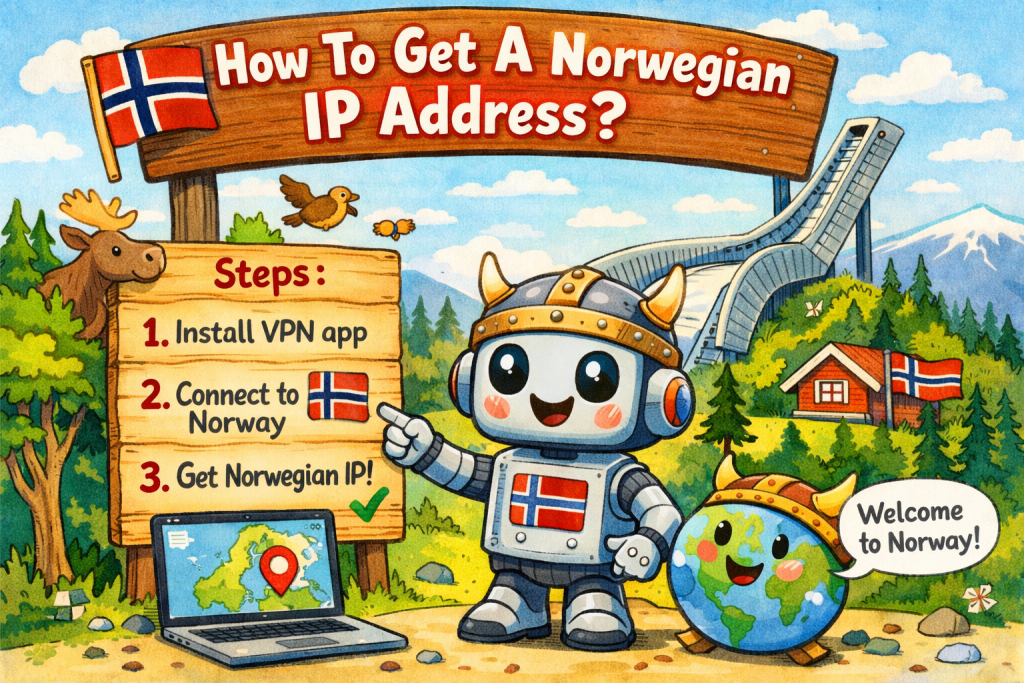
  1. Head over to the PureVPN website and pick a plan.
  2. Download the app for your device.
  3. Log in and search for “Norway” in the server list.
  4. Hit “Connect.”
  5. Success! You now have a Norwegian IP address. You can open NRK, Netflix, or your local banking app and be treated like you never left home.

Summary

An IP address is the internet’s way of keeping tabs on you, but it shouldn’t limit your freedom. Whether you’re desperate for Norwegian news, need Peppa Pig in the right language for the kids, or just want to browse securely on sketchy hotel Wi-Fi, a Norwegian IP is the key.

With a service like PureVPN, you get your entertainment back and your privacy secured. It’s a small investment for a much smoother digital life while traveling.

Are you ready to set up your digital “tunnel” back to Norway?

Free Things to Do in Oslo – How to Survive Norway’s Most Expensive City Without Selling a Kidney

Let’s address the polar bear in the room: Oslo is expensive. It’s the kind of expensive that makes you check your bank balance after buying a latte just to make sure the transaction didn’t trigger a fraud alert. We’ve all heard the legends of the €10 beer and the sandwich that costs as much as a small television.

But here is the plot twist: Oslo is also a city that loves “Free.” Because Norwegians value the outdoors and public access (a concept known as allemannsretten), you can actually have a world-class vacation here without needing to auction off a vital organ.

If you’re a budget-conscious traveler, Oslo isn’t a trap; it’s a challenge. Here is how to conquer it.


1. The Great Outdoors: Nature’s Free Gift (Since 10,000 BC)

In many cities, the “free” stuff is just the stuff nobody wanted to pay for. In Oslo, the free stuff is the highlight.

Vigelandsparken (The Park of Naked, Grumpy People)

Vigelandsparken is the world’s largest sculpture park made by a single artist, and it costs exactly zero NOK to enter. It features over 200 bronze and granite figures by Gustav Vigeland. You’ve probably seen the “Angry Boy” (Sinnataggen) on Instagram, but seeing it in person—surrounded by hundreds of other naked, wrestling, and flying humans—is a trip.

  • Budget Tip: Walking the full length of the park and its rose gardens will easily net you 5,000 steps. It’s a massive outdoor gallery that doesn’t close.

Holmenkollen: Views Without the Price Tag

While the Ski Museum and the elevator to the top of the jump cost money, walking around Holmenkollen is totally free. The area offers some of the most spectacular views of the Oslofjord. You can stand at the base of the jump, feel the sheer scale of the engineering, and hike the surrounding trails without spending a dime. Just don’t try to walk there from the city center unless you want your legs to file a formal complaint with the UN.

Window Shopping and Bull Rubbing

Strolling down Karl Johans gate is the classic Oslo experience. You can see the Parliament (Stortinget), the National Theatre, and the Royal Palace gardens. While you’re near the Central Station, make sure to take a photo with the giant bronze tiger or the bull statue. It’s the law. (Okay, it’s not the law, but your camera roll demands it.)


2. Museums in Oslo: Free or Not?

This is where things get tricky. Oslo’s museums are world-class, but they aren’t always wallet-friendly.

  • The National Museum: Usually requires a ticket, but check their website for specific evening events or occasional free entry for students or youth. It houses The Scream, which is a fitting painting for someone looking at their receipt after a night out in Oslo.
  • The Munch Museum: Generally paid, but they sometimes offer “Late Night” events or specific time slots with reduced or free entry for certain demographics.
  • Free Museums: There aren’t many “always free” museums like in London, but keep an eye on the Intercultural Museum or small local galleries in the Grünerløkka district.

Compared to Ljubljana on a budget, where you can live like royalty on a peasant’s wage, Oslo requires more strategic planning. In Eastern Europe, you expect cheap; in Oslo, you expect financial pain. But by hitting the outdoor sights, you bridge that gap.


3. The Oslo Opera House: A Free Cultural Hack

If there is one “must-do” in Oslo that feels illegal because it’s so good and yet free, it’s the Oslo Opera House.

The architects (Snøhetta) designed the building so you can literally walk on the roof. It’s a white marble slopescape that rises out of the fjord. You get a panoramic view of the city, the “Barcode” skyline, and the water.

The Hack: You can also walk into the lobby for free. The woodwork and architecture inside are stunning. You don’t need a €100 ticket to a Wagner opera to enjoy the vibe—you just need a pair of shoes and a sense of wonder.


4. Walking = Saving (The Math of Survival)

Every time you choose to walk instead of taking a tram or a bus, you’re essentially “earning” about 40 NOK.

As we’ve discussed before, walking in Oslo is highly doable because the city center is remarkably compact.

  • Central Station to the Opera House: 6 minutes.
  • Opera House to Aker Brygge: 15 minutes.
  • Aker Brygge to the Royal Palace: 12 minutes.

If you exceed 10,000 steps a day, you aren’t just getting fit; you’re saving enough money to perhaps—just perhaps—afford a beer at the end of the day. Your legs might complain, but your bank account will be singing.


5. Drink Water, Not Your Budget

If you buy a bottle of water in an Oslo convenience store, you have officially failed “Budgeting 101.”

Norway has some of the cleanest, most delicious tap water on the planet. Asking for “Vann fra springen” (tap water) in a restaurant is free and expected. Refilling your own bottle from the hotel sink is even better.

People often ask if Oslo tap water is safe, and the answer is a resounding “Yes.” It’s cleaner than most bottled water sold in other countries. By skipping the plastic bottles, you’re saving roughly 30-40 NOK per refill. Over a weekend, that’s a free meal.


6. Cheap Activities in Oslo: The Waterfront and Beyond

If you’re looking for “this is actually amazing for €0” moments, head to the Aker Brygge and Tjuvholmen waterfront.

  • The Sculpture Park at Tjuvholmen: Right next to the Astrup Fearnley Museum (which is paid), there is a small, free outdoor sculpture park by the water.
  • Sørenga Seawater Pool: In the summer, you can swim for free at Sørenga. It’s a floating park with wooden decks and a view of the Opera House. It’s the ultimate “I’m in a rich city but I’m not paying for it” experience.

Conclusion: Oslo Doesn’t Have to Be a Financial Horror Movie

Is Oslo expensive? Yes. Will a slice of pizza sometimes make you weep? Probably.

But with a pair of sturdy walking shoes, a reusable water bottle, and a focus on the city’s incredible public spaces, you can experience the best of Norway without going bankrupt. Oslo is a city designed to be lived in, and fortunately for us, the best parts—the fjord, the architecture, the parks, and the fresh air—don’t come with a price tag.