So, you’re headed to Oslo. You’ve seen the photos of the glass-and-marble Opera House, the Viking vibes, and the lush greenery. Now comes the logistical panic: Is Oslo walkable? Or are you going to end up as a cautionary tale, found shivering by a fjord because you thought you could “just nip over” to a ski jump on foot?
The short answer is: Yes, Oslo is incredibly walkable. In fact, it’s one of the most pedestrian-friendly capitals in Europe. But before you lace up your sneakers and decide to conquer the city like a modern-day Leif Erikson, there are a few things your calves deserve to know.
The “Golden Circle”: What You Actually Can Walk
If you are staying in the city center (Sentrum), your step counter is going to love you, but your legs won’t necessarily go on strike. Oslo is compact, and many of its “must-see” landmarks are clustered together like penguins in a snowstorm.
Realistic Walking Distances for Normal Humans
| From | To | Dist. | Time (Approx.) | The Reality Check |
| Oslo Central Station | Royal Palace | 1.3 km | 15–20 mins | A straight shot up Karl Johans gate. Great for people-watching. |
| City Center | Aker Brygge | 800 m | 10 mins | Totally flat. Perfect for a breezy harbor stroll. |
| City Center | Akershus Fortress | 900 m | 12 mins | Slight incline, but the medieval views are worth the burn. |
| Central Station | Opera House | 500 m | 6 mins | Practically next door. You can walk on the roof! |
| Opera House | Munch Museum | 400 m | 5 mins | You’re essentially just walking around the corner in the Bjørvika district. |
As you can see, the “Big Hits” of downtown Oslo are easily reachable without ever touching a ticket machine. Walking from the Opera House to the Munch Museum is barely a stroll; it’s more of a transition between two architectural masterpieces.
The “Maybe Take the Tram” Zone: Vigeland Park
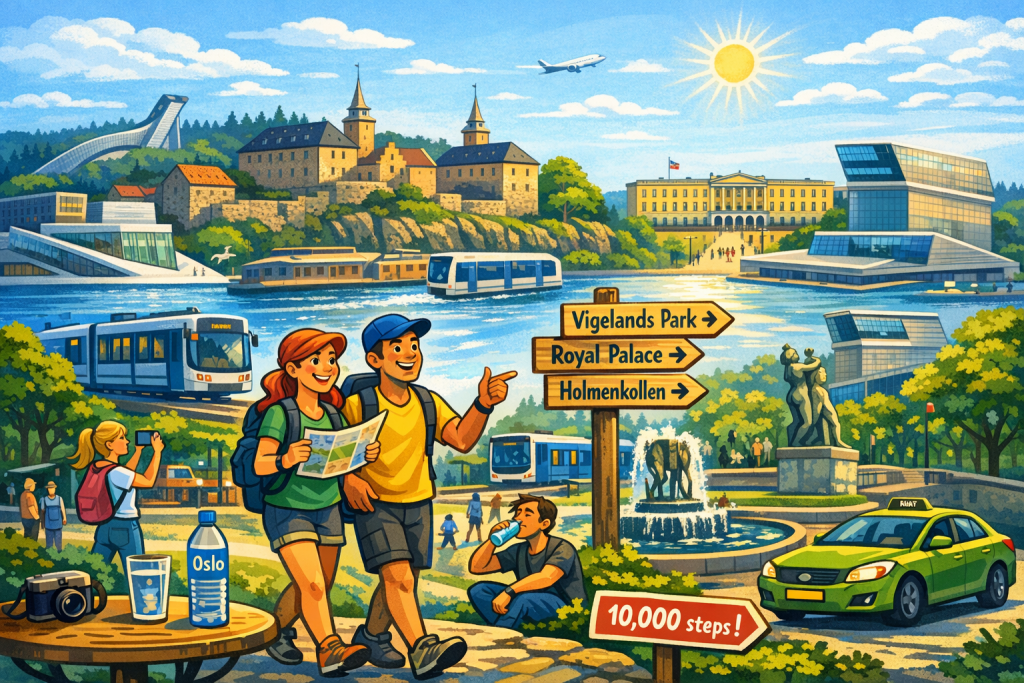
Once you decide to head west to see the famous grumpy baby statue at Vigelands Park, the conversation changes.
- The Walk: From the Royal Palace to Vigeland Park is about 2.2 km (roughly 30 minutes).
- The Trap: Many tourists forget that Vigeland Park itself is massive. Walking to the park is one thing; walking inside the park to see all 212 sculptures can easily add another 3,000 to 5,000 steps to your day.
If you’re already feeling the pinch in your arches, take the Line 12 Tram. It drops you right at the gates, saving your energy for the actual sightseeing.
Terrain, Comfort, and “The Barcelona Comparison”
Unlike some European cities that feel like a never-ending stairmaster (looking at you, Lisbon), central Oslo is relatively flat. The pavements are wide, well-maintained, and mostly pedestrianized in the shopping districts.
One major perk of walking in Oslo is the temperature. If you’ve ever attempted a mid-July stroll down Barcelona’s La Rambla, you know the “La Rambla-style sweat marathon” well. In Oslo, even the peak of summer usually hovers around a pleasant 20°C to 23°C. You can explore the city without feeling like you’re being roasted in a Viking longboat.
Pro-Tip: Wear Real Shoes
Norway is the land of “practicality over fashion.” While you’ll see locals looking stylish, they are likely wearing high-quality sneakers or boots. Leave the stilettos for a fancy dinner in Aker Brygge; the cobblestones near Akershus Fortress have a personal vendetta against thin heels.
The “Viking Reboot”: Why You Shouldn’t Walk to Holmenkollen
At some point, you will look at a map, see the Holmenkollen Ski Jump perched majestically on a hill, and think, “I can walk that. It looks close.”
Stop right there.
Walking to Holmenkollen from the city center is an 8 km uphill trek that rises hundreds of meters above sea level. Unless you are training for a “Viking Reboot” reality show or enjoy the sensation of your lungs exiting your chest, take the Metro (T-bane) Line 1. It’s a scenic 20-minute ride that does all the climbing for you, leaving you with fresh legs to enjoy the panoramic views of the fjord.
When to Stop Walking: Oslo Public Transport & Taxis
Oslo’s public transport system (Ruter) is a well-oiled machine. It consists of buses, trams, the metro, and even ferries to the islands.
- The App: Download the Ruter app. You can’t buy tickets with cash on board.
- Pricing: A single ticket costs around 40–50 NOK and is valid for an hour across all transport types. If you plan on doing more than three trips a day, a 24-hour pass is a steal.
- The Taxi Reality: A word of warning—Oslo is not a “budget taxi paradise.” Taking a taxi for a 5-minute drive can easily cost you the price of a decent lunch. Use them sparingly, perhaps only when it’s raining sideways or you’ve bought too many Norwegian sweaters.
Hydration: Don’t Buy the Bottled Water!
You’re going to be hitting a high step count, which means you need to stay hydrated. Here is the best advice you’ll get all day: Do not buy bottled water in stores.
Oslo has some of the cleanest, crispest, and most delicious tap water in the world. Buying a plastic bottle of water in a Norwegian supermarket is often cited as the stupidest question on earth because the stuff coming out of the faucet is arguably better.
Plan of Action: Bring a reusable bottle, fill it up at your hotel, and refill it at any public fountain or sink. Your wallet and the environment will both thank you.
The Verdict: Is Oslo Walkable?
Absolutely. Oslo is a dream for those who like to explore at a human pace. You can start your morning at the Opera House, wander past the Akershus Fortress, grab lunch at Aker Brygge, and finish with a stroll through the Royal Palace gardens—all without ever needing a vehicle.
However, Oslo is “walkable, but not naïve.” Know your limits:
- Walk the city center and the waterfront.
- Tram to Vigeland Park if you’re feeling lazy.
- Metro to Holmenkollen (unless you’re a mountain goat).
By mixing a bit of common sense with a sturdy pair of shoes, you’ll find that exploring Oslo on foot isn’t just possible—it’s the best way to see the city.